May 22, 2026
BlogUnderstanding M365 E7: Beware the Step-Up Offer

Microsoft rarely releases a new enterprise suite. M365 E5 arrived almost a decade ago, and nothing of comparable significance has followed until now.
M365 E7 is not an incremental upgrade. It is a platform bet on AI at the exact moment AI is rewriting enterprise technology in ways for which no multi-year agreement can fully account. That combination makes whether or not to go M365 E7 the most consequential Microsoft licensing decision in a decade. Microsoft knows it. Their field teams have been briefed, their sales motion is running at full speed, and their fiscal year closes June 30. They are not calling timeout.
The Play: Turning AI FOMO into a Hasty Step-Up Decision
Microsoft’s approach to M365 E7 adoption is not subtle. Field teams are going directly to the C-suite with an AI vision story, bypassing the IT and procurement teams who would normally conduct the due diligence. The message seems compelling: AI is transforming every industry, reshaping workforces, and redefining what competitive advantage looks like. M365 E7 is Microsoft’s answer.
The C-suite gambit has been part of Microsoft’s playbook for decades. What makes this moment different is AI FOMO. Fear of Missing Out, or FOMO, is real in the AI era. The concern that competitors are moving faster, that the automation wave will leave your organization behind, that hesitation today means falling behind tomorrow. Microsoft is capitalizing on that anxiety deliberately, and they are very good at it.
C-suite leaders are scrambling to understand and employ AI to their competitive advantage. Microsoft arrives with a bold story that sounds good, and they may not be wrong. M365 E7 could well be part of the answer.
But Microsoft does not arrive with a comprehensive agreement framework. They arrive with a step-up amendment and a signing deadline. A decision that deserves months of preparation gets compressed into weeks. And the negotiation that deserves the full weight of a major commercial event gets treated as a routine administrative action.
Why a Step-Up Is an Unbalanced Full Negotiation
This is the part that matters most and gets the least attention.
A properly negotiated M365 E7 renewal is a major commercial event. It involves usage analysis, structural term negotiation, competitive scenario modeling, multiple rounds of offers, and independent validation of whether the economics actually work for your organization. Customers who go through that process understand what they are committing to and why.
A step-up feels like a minor administrative action. You are upgrading a tier on your existing Enterprise Agreement (EA). The paperwork is lighter, the timeline is shorter, and the urgency is Microsoft’s. The decision feels smaller than it is.
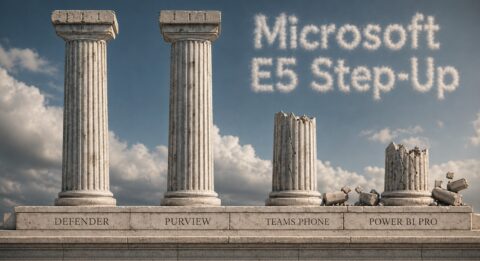
But the step-up is not a shortcut to M365 E7. It is the full E7 negotiation, conducted entirely on Microsoft’s terms and timeline. It sets the price. It locks in the structure. It establishes the baseline that everything gets measured against for the next renewal cycle. The concessions you secure– or fail to secure—in the step-up define the commercial relationship going forward. Microsoft understands this. The goal of compressing the timeline is to get you to bring step-up energy to what should be a full negotiation event. That asymmetry is not accidental.
The Three Major Step-Up Risks
Three risks deserve attention before any organization signs an M365 E7 step-up amendment.
The first is renewal leverage erosion. Whatever terms you accept today become the baseline Microsoft defends at your next full EA renewal. Pricing, structural provisions, support terms — every concession you give away under time pressure — is a concession that is difficult to recover in the negotiation that follows. A properly scoped E7 engagement would identify and address these leverage points explicitly. A compressed step-up rarely does.
The second is consumption exposure as an unmodeled variable. M365 E7 is a seat-based license sitting on top of a growing layer of Azure consumption meters that are not included in the seat price. A full E7 engagement would include analysis of that consumption exposure, including Azure meter implications, Unified Support cost impact, and protection against future model changes that shift costs from the seat to the meter. A step-up executed under deadline pressure skips that analysis entirely. You are accepting terms without a clear picture of what sits underneath them.
The third is pricing accepted without context. Microsoft evaluates your account holistically. Your Azure consumption trajectory, your Unified Support spend, your on-premises server footprint, your Dynamics investment, your cloud migration roadmap. All of it informs how they price and what they are willing to give. A well-timed M365 E7 decision is a moment to address all of those dimensions simultaneously. A Microsoft Azure Consumption Commitment (MACC) negotiation, a Unified Support restructure, a server licensing conversation. These all have more leverage attached to an E7 commitment than they do standing alone. A step-up amendment executed in thirty days under fiscal year pressure almost never captures that context. You are playing one square while Microsoft is looking at the whole board.
If You Have Not Received a Step-Up Offer Yet: Prepare Now
This is the better position to be in. Use the time.
Understand your current M365 E5 deployment reality before Microsoft does. What is your actual feature adoption across the E5 stack? What is your Copilot rollout status? How many of your users are genuinely positioned to derive value from M365 E7 capabilities today versus in twelve to eighteen months? That data shapes your negotiating position and your ability to push back on a uniform upgrade proposal.
Brief your leadership before Microsoft does. Not to say no to M365 E7, as the technology may well be the right direction, but to ensure that when the conversation happens at the C-suite level, enthusiasm gets channeled into preparation rather than commitment. The best outcome for your organization is a C-suite that says “we want this, let’s make sure we get it right” rather than one that says yes before the right people are in the room.
The step-up is the negotiation. Treating it as anything less is the costliest mistake you can make in the moment.
Take stock of your full Microsoft relationship before the conversation starts. Your Azure trajectory, your Unified Support terms, your on-premises footprint, your cloud migration roadmap. All of it has leverage value attached to an M365 E7 commitment. That leverage disappears the moment you sign a step-up without surfacing it. Do not let the step-up arrive before your preparation does.
If You Have Already Received a Step-Up Offer: Protect What Comes Next
The step-up amendment is coming. The CEO has committed and that is not a conversation you are going to reopen. What you can do is use the window between the handshake and the signature, however wide or narrow that window is, to protect what comes next.
The one thing that matters most is to make sure the step-up is a bridge to a full negotiation, not a replacement for one. That means ensuring the amendment does not automatically carry forward as the baseline for your next full EA renewal without the opportunity to renegotiate. The step-up terms may turn out to be favorable. They may not. What matters is that when your full renewal arrives, you have the right to find out. Not an assumption baked into the amendment that what you signed today is what you are living with tomorrow.
Microsoft may offer pricing protection as part of the step-up, meaning a discount schedule, a price protection clause, and a commitment that sounds generous. Read it carefully. The discount that makes the step-up look attractive today may be engineered to erode on a published timeline while your dependencies harden around the new stack. Directions analyst Steven Kelley examined exactly this mechanism in his recent analysis of Microsoft’s Multiple Equivalent Offer strategy. It is worth reading before you sign anything.
The step-up sets the table. Make sure you still have a seat at it when the full renewal arrives.
Your Move: Sound the Alarm
Spread the word inside your organization before Microsoft spreads theirs. Your IT leadership, your procurement team, your finance partners all need to know the E7 conversation is coming and what it means before it arrives at the C-suite.
The message is simple. This is not about saying no to M365 E7. It is about saying yes the right way, with the right terms, the right protections, and the right to renegotiate when the full renewal arrives.
The step-up is not a shortcut. It is the full E7 negotiation, conducted entirely on Microsoft’s terms and timeline, unless you decide otherwise.
Understanding M365 E7 Series
Part 1: Why E7 Is More Than Just a New Licensing Tier
Part 2: Beware the Step-Up Offer (this article)